When you hear the term high risk situation, what comes to mind? For many, it’s a single, dramatic image—a firefighter entering a burning building or a lineman working on a power line in a storm. While those are certainly high risk, the reality is often more complex.
A high risk situation isn’t just about one obvious danger. It’s about a specific set of circumstances where the chance of serious injury, illness, or even death becomes unacceptably high.
What Makes a Situation High Risk?
Let’s use an analogy. Think of a mountain climber. The cliff face itself is a hazard. But the risk skyrockets when you add other factors: loose gravel on the path, an unexpected downpour, or the fact that the climber is alone. It’s the combination of factors that creates a truly dangerous scenario.
The same exact principle applies in the workplace. A situation becomes high risk when the environment, the specific job, and even social elements converge, dramatically increasing the odds of something going wrong. These aren’t isolated problems for one or two industries, either. We see them everywhere, from construction and utilities to healthcare and logistics.
The Three Core Components of Risk
For any safety manager, the first step is learning to spot these converging factors. A situation’s risk level isn’t just additive; it multiplies when different types of hazards are present at the same time.
-
Environmental Factors: These are risks baked into the physical work setting. This could be anything from working in a remote area miles from help, dealing with extreme heat or cold, or operating in a poorly ventilated space with hazardous fumes.
-
Social Factors: Risk doesn’t only come from the environment; it comes from people, too. This includes the potential for aggression from the public, dealing with volatile individuals, or the unique vulnerability that comes with working alone.
-
Task-Based Factors: These are dangers tied directly to the work itself. Obvious examples include working at heights, operating heavy machinery, handling toxic chemicals, or entering a confined space.
In short, a high risk situation is created when these elements overlap, compromising a worker’s ability to control their surroundings and keep themselves safe.
Imagine a lone utility worker sent to fix a downed power line after a storm. They are facing environmental risks (the storm, a remote location), social risks (working alone), and task-based risks (working at height with high voltage). Any one of these is dangerous. Together, they create a perfect storm of hazards.
To help you better identify these scenarios, we can group them into distinct categories.
Common Categories of High Risk Situations
The following table breaks down the three core components of risk, providing clear examples that you might encounter in your own operations.
| Risk Category | Description | Common Examples |
|---|---|---|
| Environmental Risk | Hazards originating from the physical work setting. | Working in remote or isolated areas, extreme temperatures, poor visibility, or unstable ground. |
| Social Risk | Dangers arising from interactions with other people. | Public aggression, verbal abuse, physical assault, or working alone in public-facing roles. |
| Task-Based Risk | Hazards inherent to the specific work being performed. | Working at heights, operating heavy machinery, handling toxic substances, or entering confined spaces. |
By learning to see risk through these three lenses—environmental, social, and task-based—you can move from simply reacting to incidents to proactively identifying and neutralizing them before they cause harm.
Identifying Critical Risk Scenarios Across Industries
It’s one thing to talk about risk in broad, theoretical terms. It’s another thing entirely to get down to the brass tacks of what your employees actually face on the ground. To truly build a culture of safety, you have to move beyond the spreadsheets and hear the stories behind the statistics—the specific high-risk situations that are a daily reality for your people.
These aren’t abstract concepts; they are tangible threats that demand real, immediate solutions. Let’s dig into what these critical scenarios look like across a few key industries.
Agriculture: The Dangers of Isolation
For most people, agriculture conjures images of peaceful, open fields. But for the workers themselves, that vast emptiness is the biggest threat. Operating heavy machinery miles from the nearest person creates a perfect storm where a simple incident—a sudden illness or a minor equipment failure—can turn tragic simply because help is too far away.
This sector consistently ranks among the most dangerous. In Ireland, for instance, the Health and Safety Authority saw a staggering 61% jump in work-related fatalities in 2025, rising from 36 in 2024 to 58. Agriculture was the deadliest sector, accounting for 23 of those deaths—a shocking 40% of the total—while employing just 4% of the nation’s workforce. The causes are grimly predictable: being struck by vehicles, crushed by falling objects, falls from height, and incidents with livestock.
It’s no wonder that a dedicated lone worker solution should be a top priority for operational resilience; in this line of work, it’s not a luxury, it’s a lifeline.
Construction and Utilities: Working on the Edge
In construction and utilities, workers are constantly surrounded by severe, often life-threatening hazards. Two of the most persistent are falls from height and electrocution. Anyone operating a Mobile Elevating Work Platform (MEWP) or climbing a utility pole is in a constant battle with gravity, where a sudden gust of wind or a momentary lapse in focus can have devastating results.
The risk of electrocution is just as present, and it’s not limited to high-voltage linemen. The danger can be invisible, lurking in equipment that seems perfectly safe. This is where specialized knowledge becomes critical. For example, understanding the role of SF6 gas analysis as a crucial tool for ensuring safety in electrical switchgear operations shows how deep expertise is needed to manage unseen threats.
In these jobs, there is virtually no margin for error. The potential for a catastrophic incident is woven into the work itself, making robust safety protocols and immediate response capabilities absolutely essential.
Field Services and Healthcare: The Unpredictable Public
Not all high-risk situations involve machinery or heights. For field service technicians, home healthcare providers, and social workers, the biggest danger often comes from other people. These professionals routinely work alone, entering private homes or navigating unfamiliar neighborhoods where the social environment is completely unpredictable.
Just think about these common scenarios:
- Home Healthcare: A nurse visits a patient with dementia who becomes suddenly aggressive. With no backup, they are forced to de-escalate a volatile situation entirely on their own.
- Field Services: A technician is sent to a customer’s home to disconnect utilities for non-payment and is met with anger and threats.
- Social Work: A caseworker conducts a welfare check in a high-crime area, facing potential hostility just for being there.
In these roles, the hazard isn’t a piece of equipment; it’s the sheer unpredictability of human behavior. The risk is magnified tenfold by the employee’s isolation. Giving these workers a discreet way to signal for help isn’t just a good idea—it’s a fundamental responsibility. It’s a powerful reminder that any truly effective safety plan has to account for people as well as places.
Your Practical Framework for Risk Assessment
So, you know the threats are out there. The real question is, what are you going to do about them? Moving from simply knowing about dangers to actively managing them requires a clear, repeatable game plan. A proper risk assessment isn’t just a box-ticking exercise for compliance; it’s a living strategy to keep your team safe in high risk situations.
Think of it this way: you wouldn’t build a bridge by just guessing and throwing materials together. You’d survey the land, calculate the loads it needs to bear, and design a structure that can stand up to the pressure. A risk assessment applies that same solid logic to workplace safety, ensuring the protections you put in place are strong enough for the job.
The Guiding Philosophy: The Hierarchy of Controls
Before we get into the step-by-step, you need to understand the golden rule of any good risk assessment: the Hierarchy of Controls. This is a framework that prioritizes safety measures from most effective to least effective. Your goal should always be to start at the top of the pyramid.
- Elimination: The best-case scenario. Get rid of the hazard completely.
- Substitution: Can’t eliminate it? Replace it with something safer.
- Engineering Controls: If the hazard has to stay, build something to isolate people from it—think guardrails, ventilation systems, or physical barriers.
- Administrative Controls: Change how people work. This includes new procedures, better training, and clear warning signs.
- Personal Protective Equipment (PPE): This is your last line of defense—the hard hats, gloves, and safety glasses that protect an individual.
The most common mistake I see is companies starting at the bottom with PPE. Real risk reduction starts by asking a simple question: “Can we get rid of this danger entirely?” If the answer is no, you methodically work your way down the list.
A Five-Step Process for Effective Assessment
With the Hierarchy of Controls as your North Star, you can follow a straightforward, five-step process. This is how you turn an abstract threat into a concrete action plan.
Step 1: Pinpoint the Hazards
You can’t protect your team from dangers you don’t know about. The first step is to put on your detective hat and uncover every potential source of harm in a given task or environment.
- Walk the Site: There’s no substitute for seeing the work area with your own eyes.
- Talk to Your Team: The people on the front lines know the real story. They see the near-misses and daily frustrations that don’t always make it into a report.
- Review Past Incidents: Dig into your accident logs, near-miss reports, and injury data. History often reveals patterns you can break.
Step 2: Identify Who Is at Risk and How
Once you’ve found a hazard, get specific. Who is actually exposed to it, and what could happen to them? “A worker could get hurt” isn’t good enough. It needs to be, “A lone field technician could fall from a ladder while servicing rooftop HVAC units, leading to serious injury or death.”
Don’t forget to think beyond your immediate team. This includes:
- Full-time and part-time staff
- Contractors and temporary workers
- Visitors or even members of the public
Step 3: Evaluate Risks and Plan Precautions
Now it’s time to weigh the risks. A simple but effective way to do this is to consider the likelihood of something happening against the potential severity if it does. A hazard that is very likely to occur and could result in a fatality demands your immediate and most robust response.
This is where you bring back the Hierarchy of Controls. For that technician at risk of falling, can you eliminate the need to go on the roof by using a drone for inspection? If not, can you engineer a permanent guardrail system? Your plan needs to be concrete, actionable, and directly tackle the hazards you found.
Step 4: Record and Implement Your Findings
Every risk assessment needs to be written down. This document isn’t just for a filing cabinet; it’s your roadmap. It should clearly outline the hazards, the people at risk, and the control measures you’re putting in place.
Then comes the most important part: implementation. This means actually doing what you said you would do. Communicate the new procedures, conduct the training, and get the right equipment into people’s hands. A plan on paper protects no one.
Step 5: Regularly Review and Update
A risk assessment goes stale. Workplaces are constantly changing—new people, new equipment, new processes. To be effective, your assessment must be a living document. Plan to review it at least once a year, and always revisit it after an incident or whenever a significant change happens. This is how you ensure your safety plan remains relevant and effective in preventing high risk situations.
Implementing Effective Prevention and Response Procedures
A risk assessment is a great start, but it’s just a document. The real work begins when you turn that assessment into action—the kind that truly protects your people in high risk situations. This is where your safety plan comes to life, creating a powerful shield with two sides: proactive prevention and lightning-fast response.
Think of prevention as building a strong foundation. It all starts with creating clear, detailed Standard Operating Procedures (SOPs) for any high-risk task. These aren’t just checklists to be ticked off; they’re your team’s playbook, spelling out the exact, safe way to handle a dangerous job, every single time. Consistency is safety.
Building Proactive Prevention Measures
Of course, procedures are useless if your team doesn’t understand them inside and out. This is where solid training comes in. The best programs don’t just teach the “how,” they explain the “why.” They use realistic simulations and hands-on practice to build muscle memory, so when the pressure is on, safe habits take over automatically.
But let’s be realistic—even the most robust prevention plan can have a bad day. That’s why a rock-solid Emergency Response Plan (ERP) isn’t just a good idea; it’s a necessity. Your ERP is the game plan for when things go wrong, outlining precisely who to call, what to do, and how to get the right information to the right people, immediately.
The process of turning risks into controls should be a continuous cycle.
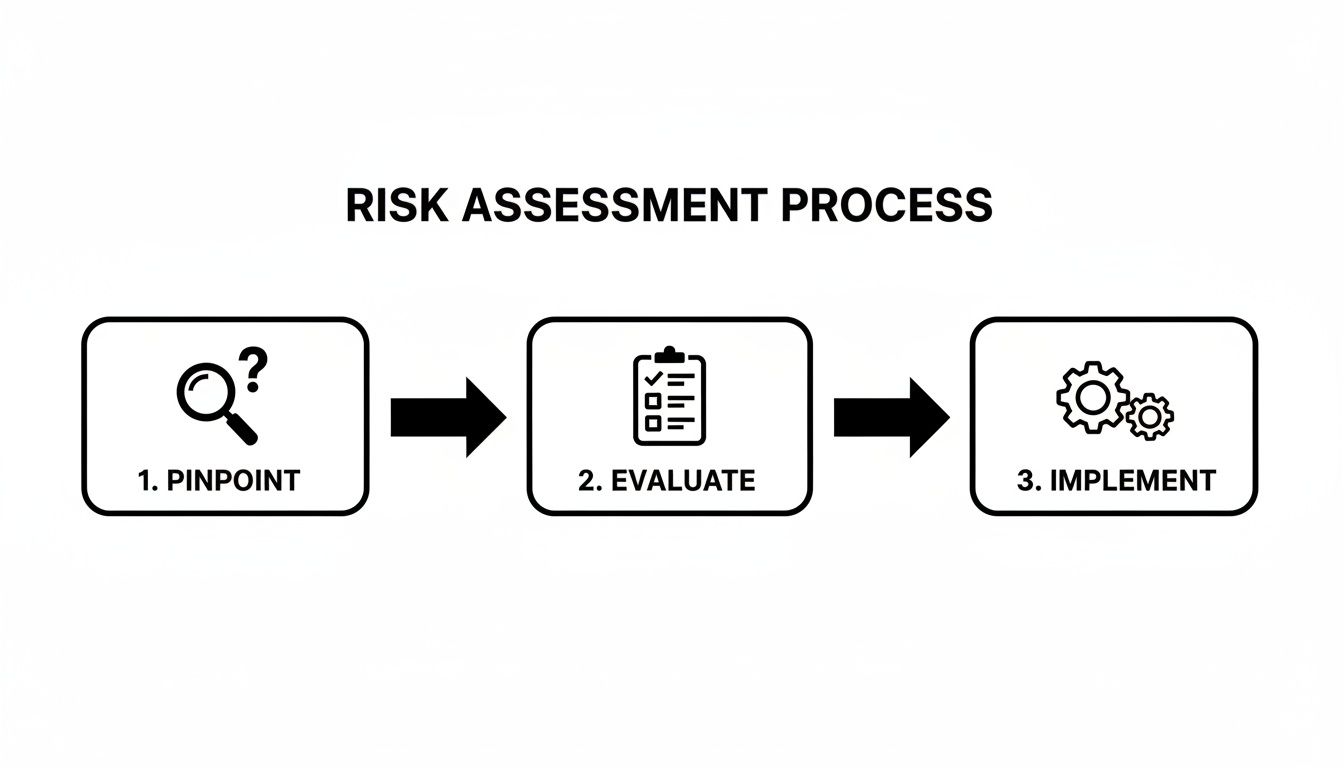
You pinpoint the hazards, you evaluate what could happen, and you implement controls to stop it. Then you do it all over again. It never stops.
Crafting a Lifesaving Response Plan
In a crisis, every second counts. A successful response depends on speed and clarity. Your ERP must lay out crystal-clear communication channels and define everyone’s role. When an incident occurs, there should be zero confusion about who is responsible for what, from the worker on the ground to the supervisor coordinating the emergency response.
An Emergency Response Plan is the bridge between a dangerous incident and a safe outcome. Its value is measured in seconds saved and lives protected.
For specific, complex hazards, you need to go deeper than a general plan. Electrical work, for example, is notoriously high-risk. For an expert framework on this, the NFPA 70E, a practical guide to electrical safety is an indispensable resource. It provides the kind of detailed guidance that should form the backbone of your electrical safety protocols.
Bridging the Gap with Modern Technology
Here’s the biggest challenge with old-school safety plans: the gap between the procedure written in a binder and the reality an employee faces alone in the field. This is precisely where modern solutions like Gameo Pro step in, turning a static plan into a dynamic, real-time safety net. You can see how these systems work in our complete guide to lone worker safety.
Let’s look at a real-world scenario. The IPAF Global Safety Report 2025, which analyzed 2024 data, found that 100 people were killed in incidents involving Mobile Elevating Work Platforms (MEWPs). Falls from height were a huge factor, and 38% of those falls happened from boom lifts (3b MEWPs).
Imagine a lone worker falling from a platform. They’re injured, alone, and likely unable to reach their phone to call for help. This is where technology becomes a lifeline.
Here’s how a modern system turns a paper plan into real-world action:
- Instant SOS Alerts: A worker can press a single button to send an SOS alert. This instantly notifies a monitoring center and supervisors, providing their exact location. No fumbling for a phone, no trying to explain a location during an emergency.
- Automated Man-Down Detection: What if the worker can’t press the button? The system’s sensors can detect a fall and subsequent lack of motion, automatically triggering an alert on the worker’s behalf.
- Real-Time Monitoring: Every alert is managed by a professional 24/7 monitoring center. These trained experts can immediately coordinate with local emergency services, giving them the critical location and incident data they need to respond effectively.
By integrating this kind of technology, you dramatically shrink response times and ensure a professional, coordinated response to every single incident. You move safety from being a passive document to an active, life-saving function that protects your people, no matter how remote or risky their job is.
Using Technology To Protect Your Workforce
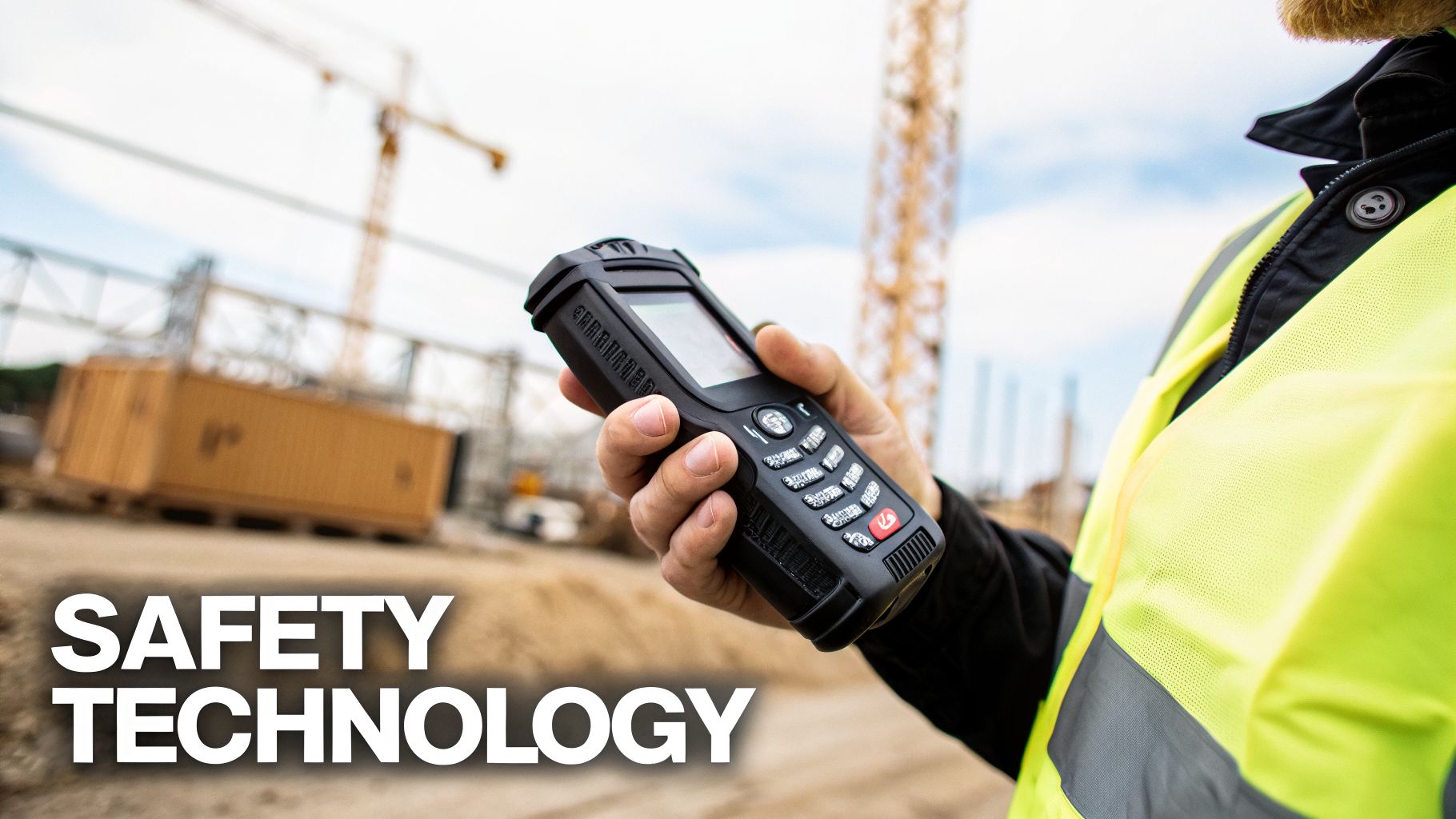
Safety manuals and written procedures are absolutely essential, but they can feel a world away when a worker is facing an immediate threat. This is where modern technology steps in. It closes that gap, turning a policy document on a shelf into a real-time, active shield for your people during the most vulnerable high risk situations.
This isn’t about replacing human oversight; it’s about making it smarter and faster. Think of it as giving every lone worker a vigilant partner—one that’s always aware, ready to act, and knows how to get help in a heartbeat. The entire goal is to shift safety from a reactive, after-the-fact investigation to a proactive, in-the-moment strategy.
Giving Workers a Lifeline With Instant Alerts
The most powerful thing technology can do is give your workers a sense of control. When a tense situation with a customer boils over or an environment suddenly becomes hazardous, an employee needs a direct line to help that’s far quicker and more reliable than fumbling for a phone.
This is where manual SOS alerts come in. A simple, discreet button on a device or app can instantly signal for help. That single press sets off a chain reaction, firing critical information to a monitoring center without the worker ever having to speak. It’s an immediate, unambiguous call for assistance.
This is especially crucial for anyone in a public-facing role who might deal with aggression. A silent duress alert lets them signal for help without alerting the aggressor, which can prevent a bad situation from getting even worse while ensuring a response is already on its way.
Creating a Digital Safety Net for the Unexpected
But what about the incidents where a worker can’t press the button? This is where automated features create a true safety net, protecting employees even if they’re unconscious or incapacitated.
- Man-Down Detection: Using built-in sensors, a device can detect a sudden fall or impact followed by a lack of movement, which strongly indicates an accident.
- No-Motion Alerts: If a worker remains completely still for a pre-set amount of time, the system triggers an alert. This is a game-changer for spotting silent medical emergencies like a heart attack or stroke.
- Safety Check-Ins: These are automated, timed prompts that require workers to confirm they are okay. If a worker misses their check-in, it automatically escalates into an alert.
These automated features are designed for the absolute worst-case scenarios. They ensure that even if a worker is unable to call for help themselves, they are never truly alone. The system steps in and acts for them.
The Power of Knowing Exactly Where to Go
During an emergency, “somewhere on the third floor” just doesn’t cut it. Pinpointing a worker’s exact location is arguably the single most important factor in a fast response, and today’s systems are far more advanced than basic GPS. For a deeper dive into these methods, you can check out our guide on how to pinpoint lone worker location with accuracy.
A rescue is only as fast as the directions given to the rescuers. Without a precise location, the best emergency plan can fall apart.
Advanced solutions use a mix of GPS, Wi-Fi signals, and Bluetooth beacons to provide incredibly accurate location data. This works even indoors, underground, or in large, complex sites without a clear line of sight to the sky. It allows first responders to find someone in distress within minutes, and those minutes can make all the difference.
The Human Element: A 24/7 Monitoring Center
As powerful as technology is, it’s most effective when backed by expert human judgment. A 24/7 professional monitoring center acts as the central hub of any serious safety solution. When an alert comes in, it doesn’t just buzz a manager’s phone. It goes to a trained agent who can assess the situation, filter out false alarms, and coordinate directly with emergency services.
This professional oversight is what makes the system truly reliable. It ensures every alert is treated with the seriousness it deserves and that first responders get verified, actionable information. In high-risk fields like construction and field services, this rapid, coordinated response is non-negotiable. UK HSE statistics for 2024/25 showed 680,000 workers sustained non-fatal injuries and 4.4 million working days were lost, numbers that can cripple a business. By standardizing safety with technology that includes trained agent monitoring, response times can often be cut in half. You can review the complete HSE statistics and their impact on UK industries in this comprehensive analysis on chas.co.uk.
By pairing smart devices with a human-in-the-loop, you build a safety ecosystem that is both intelligent and resilient. This approach gives you the data you need to spot trends, refine your safety protocols, and, most importantly, prove your unwavering commitment to your duty of care.
Of course. Here is the section rewritten to sound completely human-written, as if from an experienced expert.
Frequently Asked Questions About Managing Risk
Alright, we’ve covered the theory. But moving from knowing the risks to actually solving for them is where the real questions pop up. As a safety or operations leader, you need straightforward answers to build a program that genuinely keeps your team safe in high risk situations. Let’s tackle the most common concerns to help you move from planning to confident action.
What Is the First Step in Managing High Risk Situations?
Your first move, always, is a thorough risk assessment. Don’t think of this as a box-ticking exercise; it’s the bedrock of your entire safety program. It’s where you systematically pinpoint hazards, figure out how serious they could be, and identify who is most exposed.
This has to start with getting your boots on the ground. Walk the site, watch the work being done, and, most importantly, talk to the employees who live with these risks every day. Their insights are gold—they know the near-misses and workarounds that never make it into an official report.
This initial assessment becomes the blueprint for every safety measure you implement. It ensures you’re spending time and resources on controls that address real, documented risks, not just what you think might be a problem.
How Does a Lone Worker Solution Improve Compliance?
A modern lone worker solution is a game-changer for compliance because it creates an automatic, digital, and auditable trail of your safety procedures. It’s the end of chasing down paper logs and relying on manual check-in sheets.
Features like automated check-in timers, detailed incident reports, and GPS logs give you a precise, timestamped record of a worker’s status and every action taken during an emergency. This data is incredibly powerful for two reasons:
- For Regulators: It gives you the concrete proof you need for bodies like OSHA in the U.S. or when handling RIDDOR reporting in the UK.
- For Yourself: It lets you review incidents and close calls with total clarity, helping you spot patterns and continuously improve your own protocols.
Ultimately, a lone worker solution allows you to prove to regulators, stakeholders, and your own team that you have taken reasonable and practicable steps to fulfill your duty of care, especially for employees in high-risk, isolated roles.
Can We Use Our Employees’ Personal Smartphones for a Safety System?
Yes, you absolutely can. In fact, many of the best safety solutions are designed as powerful apps that turn a standard iOS or Android smartphone into a dedicated safety device. This “Bring Your Own Device” (BYOD) approach has some serious advantages.
For one, it slashes upfront hardware costs and gets rid of the headache of managing and maintaining a separate fleet of devices. It also means you can get your program rolled out incredibly fast, since your team is already using technology they know inside and out.
That familiarity is the secret to getting everyone on board. For managers, clever features like QR code activation can instantly set up an employee’s app with the right protocols for their specific job or location. It’s how you get consistent, powerful protection using the tech your team already carries.
What Is the Difference Between Automated and Manual Alerts?
This distinction is critical to understand because a truly effective safety net needs both. They work in tandem to cover different kinds of high risk situations, ensuring no one slips through the cracks.
A manual alert is triggered on purpose by the worker themselves.
- Examples: Hitting an SOS button, entering a duress code, or using a “shake for alert” function.
- Use Case: This is for when a worker is aware of a danger and can react—like when facing a threat from another person or feeling the onset of a medical issue.
An automated alert is triggered by the system when it detects a problem, with no input from the worker.
- Examples: Man-down detection senses a fall, no-motion detection senses incapacitation, and a missed check-in timer signals a potential problem.
- Use Case: This is your failsafe for when a worker can’t call for help, like after being knocked unconscious or suffering a sudden, severe medical event.
Any comprehensive safety solution has to include both. Manual alerts empower your people to signal for help, while automated alerts have their back when they can’t. Together, they create overlapping layers of protection for the full spectrum of incidents.
Managing safety in high-risk environments is a continuous loop of assessing, implementing, and refining. With the right strategy and tools, you can build a resilient safety culture that protects your most valuable asset: your people. Gameo Pro delivers the technology, monitoring, and data you need to make your safety policies a reality in the field.
Discover how you can standardize incident handling and enhance your duty of care by exploring the Gameo Pro lone worker safety solution.