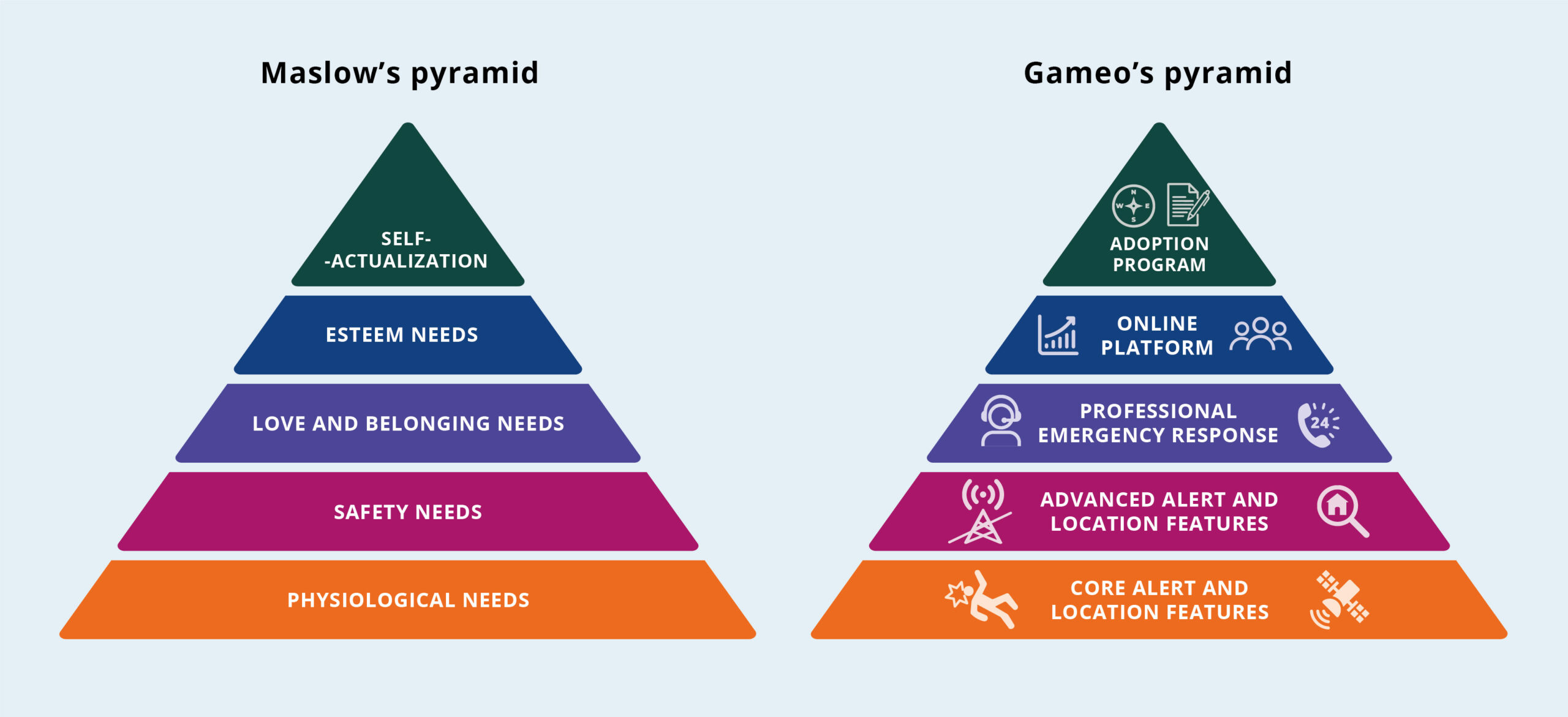
Few organizations ask the question: “What actually defines a lone worker safety solution?”
There are no regulations that provide a checklist of capabilities or features. So how can organizations compare different solutions and then successfully implement one that works appropriately?
By adapting Maslow’s Pyramid, organizations can find a simple, precise, and directly applicable definition.
Is There a Legal Definition for a Lone Worker Safety Solution?
The simple but unsatisfying answer is that there is no legal definition. However, insurers have worked to create frameworks that apply across different markets and applications:
- In Germany, the DGUV 112-139 standard specifies alert functions;
- In Switzerland, the SUVA document links risks to the alert functions that should be used to manage them.
In Britain, the BS 8484 standard is issued by the British Standards Institution. Its emphasis on professional emergency response makes this standard uniquely comprehensive.
Our Proposed Definition for Lone Worker Safety Solutions
A lone worker safety solution must include three inseparable elements:
- Alert and location functions. These alert functions are triggered voluntarily and also detect any incident automatically, without user action;
- Professional emergency response, available 24/7. The agent follows the procedure defined by the company and verifies the alert if needed;
- Robust data. A platform with usage indicators and functions to update data.
The solution must also provide substantial training, methods, and tools to ensure real-world adoption by lone workers.
The Gameo Pyramid—An Effective Approach to Lone Worker Safety
Here is Maslow’s Pyramid, or rather, the Gameo Pyramid. It’s been adapted specifically for effectiveness in supporting lone worker safety and protection, according to the above definition:
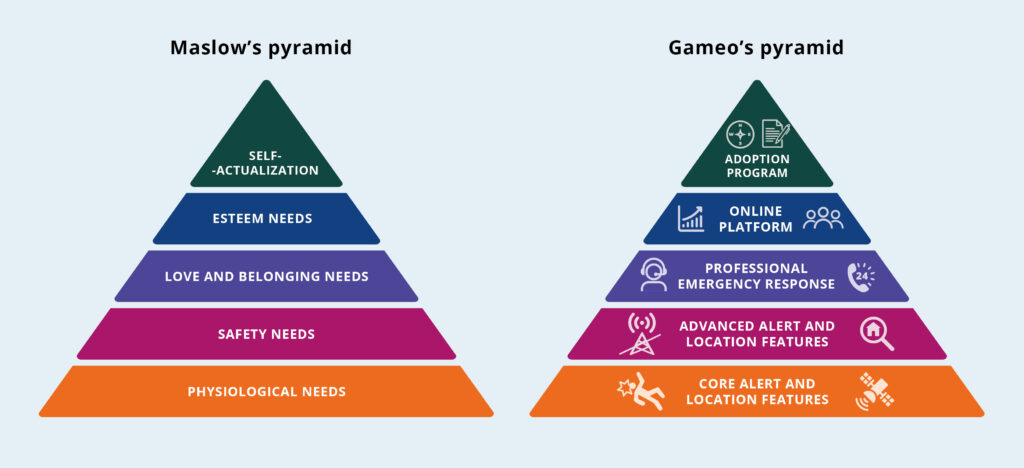
Core Alert and Location Functions
- Manual alerts: SOS button, duress alert
- Automatic alerts: man-down, no-motion, safety check-in
- Real-time location: GPS technology
Advanced Functions
- Off-grid alert (alerts outside cellular/wi-fi coverage),
- Indoor location tracking
Professional Emergency Response
- Alert management by an Emergency Response Center (ERC) agent
Online Platform
- Indicators and reports on actual usage,
- Updates to information including emergency procedures
Real-World Adoption
- Method and approach to ensure successful implementation and genuine, ongoing use
Use The Gameo Pyramid to Assess Your Solution Choices
Step 1: Rule out anything unrelated to a lone worker safety solution
Some organizations have a call center that regularly contacts an on-call technician in the event of an incident. What can the technician actually do? If the technician doesn’t answer, what information does the company have (location, in particular) and what can it do about it?
Field service management (FSM) or field force automation platforms sometimes include a lone worker function. Ask the same questions in these contexts.
Step 2: Eliminate products that only partially meet the Gameo Pyramid
The Gameo Pyramid is an essential baseline that reduces risk and supports lone worker safety. There is no business value to a product that doesn’t contribute to safety in every situation, at all times.
If the provider doesn’t offer tools and a process to drive real-world adoption, it’s not a solution: it’s just an empty marketing campaign. Like any new solution introduced into an organization, it requires proper support and roll-out. What good is a lone worker alarm device that goes unused?
Step 3: Do your analysis
The goal isn’t to use every function, but to have a solution that meets every potential need. As a reminder, it’s not the users’ job to evaluate a solution in the field. Otherwise, you risk falling into the “security blanket syndrome”: a nice, reassuring product that ultimately fails to provide real performance, safety, and value.
Using the Gameo Pyramid, you can quickly narrow down your choices, engage in field testing, and ultimately make a more informed and confident final decision.
Gilles Rooss, founder